Türkçe
 English
Climate Law Proposal: Emissions Trading System is Coming
Countries Worldwide Are Developing New Policies to Reduce Carbon Emissions
Countries around the world are developing new policies to reduce carbon emissions and achieve sustainable development goals. In line with this, Türkiye has taken a significant step by submitting the Climate Law Proposal to the Turkish Grand National Assembly (TBMM).
This law represents a major transformation in establishing an Emissions Trading System (ETS), regulating carbon markets, and accelerating the green transition in the industry within the scope of the 2053 Net Zero Emission Target.
In this article, we will examine the contents of the Climate Law, its impacts on the business world, and Türkiye’s integration into global carbon markets.
What Does the Climate Law Proposal Include?
Türkiye’s Climate Law introduces regulations that will directly affect the industrial, energy, trade, and finance sectors. Its main components are:
-
Mandatory Emission Reporting: Businesses will be required to report and verify their greenhouse gas emissions within specified periods. Companies that fail to comply will face fines ranging from 500,000 TL to 5 million TL.
-
Protection of the Ozone Layer: Businesses importing, using, or trading substances that harm the ozone layer will face fines up to 2.5 million TL.
-
Emissions Trading System (ETS): A carbon pricing system will be implemented to regulate Türkiye’s carbon markets. The Energy Markets Operations Company (EPİAŞ) will oversee the ETS market operations.
-
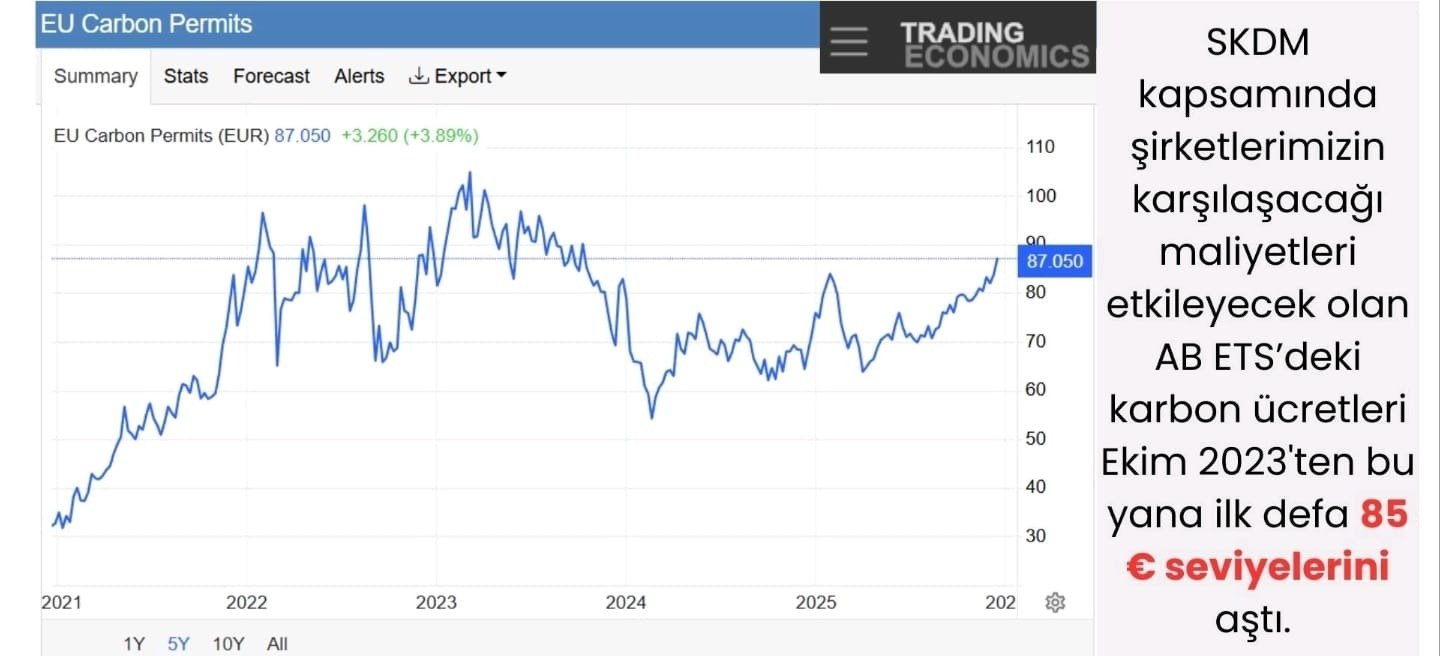
Alignment with the Carbon Border Adjustment Mechanism (CBAM): To comply with the EU’s CBAM regulations, Türkiye will introduce carbon pricing. Companies adapting to the Turkish ETS will be in a more favorable position to pay lower carbon taxes under the EU ETS.
-
Green Finance and Incentives: Under the Türkiye Green Taxonomy, investments in renewable energy, energy efficiency projects, zero-waste applications, and sustainable production models will be supported.
-
Low-Carbon Transformation in Industry: Industrial enterprises will reduce emissions by investing in renewable energy, adopting circular economy models, and implementing energy efficiency solutions.
Impact of the Climate Law on the Business World
The Climate Law will bring fundamental changes to Türkiye’s industrial, energy, and export sectors. Carbon pricing will reshape cost structures in industries and make investments in carbon reduction inevitable.
Key Impacts:
✔ Advantages for Exporting Companies: A CBAM-aligned ETS system will help Turkish companies maintain their competitive edge in trade with the EU.
✔ Increase in Investment Costs: Companies failing to reduce their carbon emissions will need to purchase carbon credits, leading to additional costs.
✔ Rise in Energy Efficiency Investments: Businesses will need to invest in renewable energy projects to mitigate ETS-related costs.
What Are We Doing at Hexagraphene?
At Hexagraphene Nanotechnology, we provide innovative solutions to accelerate the industry’s transition to a low-carbon economy.
We support businesses in aligning with Türkiye’s Emissions Trading System (ETS), optimizing carbon management processes, and transitioning to sustainable business models.
Our Key Solutions:
- We develop energy management and efficiency projects for industrial and commercial facilities to help them optimize energy consumption, reduce operational costs, and establish sustainable energy management strategies.
- Using real-time data tracking and analytics, we help businesses accelerate their transition to a low-carbon economy.
- We provide comprehensive solutions for carbon footprint calculation, energy management systems, and access to green finance to ensure companies comply with ETS regulations.
You can leverage Hexagraphene’s solutions to enhance your carbon management processes and accelerate your sustainable transformation!
A New Era for Türkiye Begins!
Türkiye’s Climate Law marks the beginning of a new era for the industrial and energy sectors. This law aims to effectively implement carbon trading systems, accelerate the green transformation of industries, and maintain international competitiveness. However, its effectiveness and sectoral impact will become clearer over time.
At Hexagraphene Nanotechnology, we are committed to guiding businesses through Türkiye’s transition to a low-carbon economy.
???? Contact us today to reduce carbon emissions with sustainable solutions!