Türkçe
 English
Hexagraphene Nanotechnology Publishes Analysis on Developments in Waste Management and Recycling Sectors in Turkey and Globally
Hexagraphene Nanotechnology has released an analysis addressing developments in waste management and recycling sectors both globally and within Turkey. The published study seeks to answer key questions such as:
-
“Which sectors in Turkey have high recycling potential and are attractive for investment?”
-
“How can companies gain competitive advantage in both domestic and global markets by complying with regulations?”
-
“What strategic approaches should be considered for successful market entry?”
-
“Which distinctive competencies should be prioritized for investment in the sector?”
The report also highlights the importance of increasing financial incentives and expanding the use of digital monitoring and sorting technologies for Turkey to achieve its recycling targets. These elements are emphasized as key opportunities for improving the country’s global competitiveness and increasing recycling rates.
Global Recycling Policies Are Creating New Markets
Driven by regulations such as the European Union’s Circular Economy Action Plan and Waste Framework Directive, the global recycling market is growing rapidly. The EU aims to recycle 65% of municipal waste by 2035. As regulations tighten and waste volumes rise, new investment opportunities are emerging. However, infrastructure deficiencies and lack of awareness remain major challenges in the transformation process.
Recycling Rates in Turkey Could Increase – Infrastructure Investments Will Be Key
While global municipal waste is expected to reach 3.8 billion tons by 2050, initiatives such as Turkey’s Zero Waste Project are contributing to a downward trend in waste generation. Between 2020 and 2022, municipal waste decreased to 32.4 million tons with a CAGR of -3.2%, but only 30% of it is currently recycled (compared to the EU average of 49%).
Meanwhile, the total amount of domestic waste in Turkey increased with a CAGR of 2.1%, reaching 109.2 million tons in 2022. Key waste sources include the manufacturing industry (especially metals, chemicals, plastics), thermal power plants, and household waste. Increasing technological investments in sectors such as steel and textiles indicate growing sectoral competition.
In 2022, the number of waste processing facilities across Turkey reached 3,136, showcasing momentum in the sector. However, it is clear that further infrastructure investments are necessary to meet recycling targets.
Critical Developments in Turkey’s Waste Management Policies
Thanks to the Zero Waste Project, Turkey’s overall recycling rate rose to 34.92% in 2023. The target for 2035 is 60%. With the Deposit Return System (DRS) set to be implemented in 2025, the return of packaged beverages will be encouraged, aiming to recover approximately 25 billion packages annually and contribute €520 million to the economy.
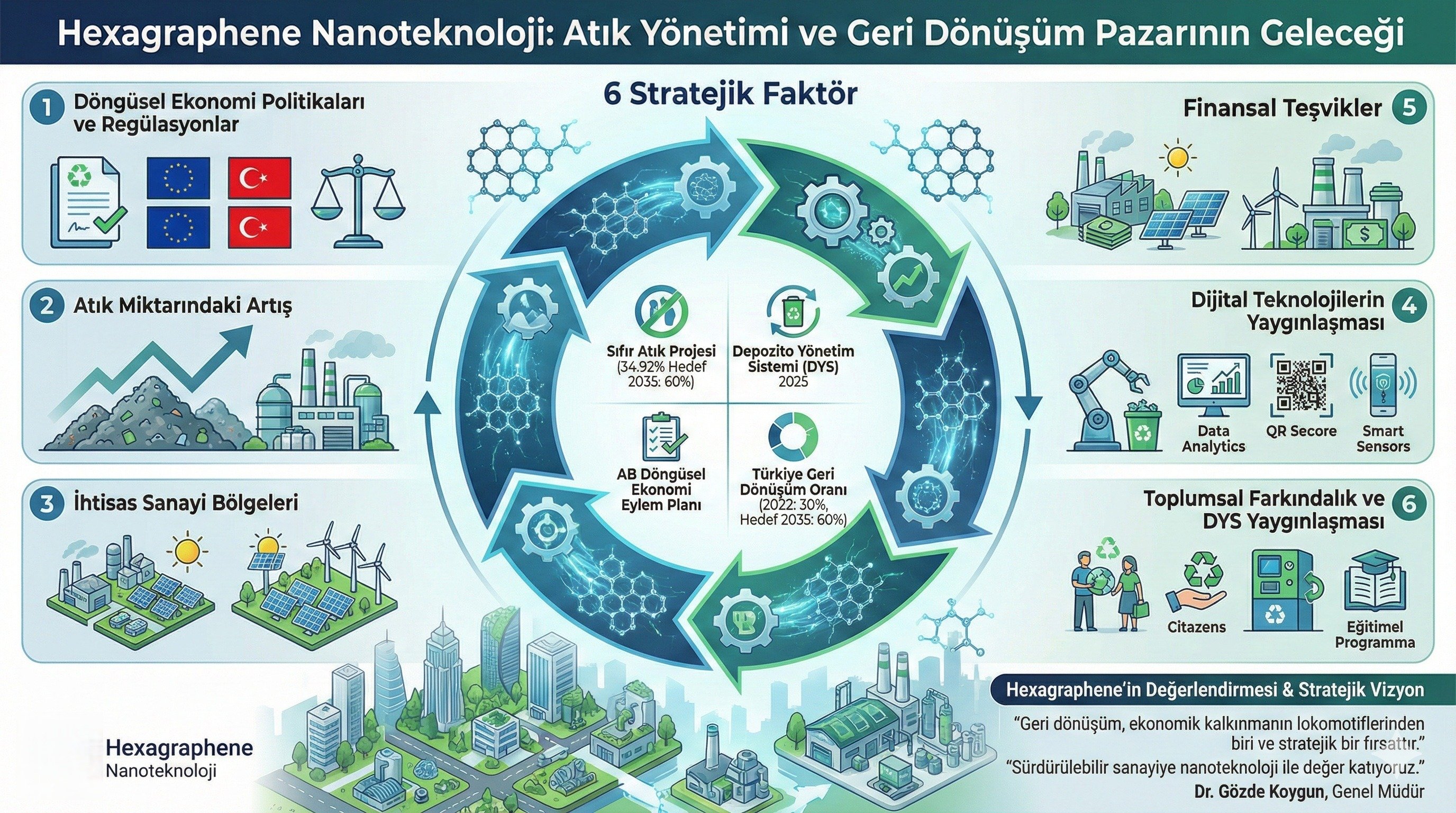
Hexagraphene’s Analysis: The Future of the Recycling Sector Depends on 6 Strategic Factors:
-
Circular Economy Policies and Regulations
In line with EU regulations and Turkey’s Zero Waste goals, sectors with high recycling potential such as plastics, textiles, and steel are expected to see increased investment and mergers. -
Increase in Waste Volume
Industrialization and urbanization are expected to boost waste volumes, necessitating capacity expansions in recycling facilities. -
Specialized Industrial Zones
Establishing industrial zones dedicated to recycling, modernizing waste management in metropolitan areas, and integrating existing facilities with renewable energy systems will support sectoral growth. -
Spread of Digital Technologies
Digitalization in monitoring systems and sorting technologies increases the efficiency of recycling processes. With its R&D capabilities and young workforce, Turkey is well-positioned to strengthen its competitive advantage in this area. -
Financial Incentives
To support sustainable growth and balance energy costs in the recycling sector, tax exemptions, subsidies, and funding support will play a critical role. -
Public Awareness and Expansion of DRS
Raising awareness among citizens on waste separation and the widespread adoption of systems like the DRS will accelerate the transition to a circular economy.
Strategic Commentary from Hexagraphene
Dr. Gözde Koygun, General Manager of Hexagraphene Nanotechnology, shared the following remarks on the report:
“Recycling is no longer just an environmental responsibility—it has become one of the driving forces of economic development. Global regulations and sustainability targets are turning the circular economy model into a strategic opportunity rather than a mere obligation. For this transformation to accelerate in Turkey, private sector investments, regulatory compliance, and technological infrastructure will be of critical importance.”
“At Hexagraphene, we will continue to contribute to the waste management and recycling sectors with our advanced technology solutions that reduce carbon emissions, and we remain committed to guiding the future of sustainable industry.”